My Friend Flicka-by Mary O’ Hara

So as I said in an earlier post, I acquired this book along with the sequel, Thunderhead, from my granny, Frances Grimes, many years ago. I loved them as child and decided to read them again during the Covid lockdown last year. They rekindled my love of horse stories, so I became more serious about writing my own. I’m currently plugging away at The Red Filly, one chapter at a time. I actually created a rough outline/beat sheet, so I do know where I’m going with it at least. I joined an awesome writing group during all this Covid mess and they are helping me with edits along the way. This pandemic has been rough on all of us, but I’ve managed to achieve a few positives after I figured out how to restructure my life. I often wonder, if I am forever changed by the last year and a half…but I digress…on to the review!

This is a story of true love between a boy and horse. It’s the kind of bond a young horse loving, apartment dwelling girl like I was growing up, dreamed of. The main character, Ken McLaughlin, unlike me and probably a great many of the kids who have read this book over the years, is growing up on a ranch in Wyoming in the late 1930s surrounded by horses. But, he longs for one of them to be his very own. He’s a day dreamer and because of this causes many mishaps around the ranch and can’t focus on his school work, so his father doesn’t want to reward him with a yearling to raise as his own like his older brother has done.

Mom comes to the rescue though, as she often does in this book and the sequel, Thunderhead. She insists that Ken needs a yearling to raise to help him focus. After a horrific incident during the gelding of the yearling colts, Ken decides he doesn’t want the gruesome procedure carried out on his yearling. He decides he wants a filly to avoid the barbaric practice. But in his father’s eyes he picks the worst filly on the ranch. She’s been running wild with her dam her entire short life and won’t allow anyone near her.

I don’t want to give away the whole story, but you get the idea. Ken is determined, his dad is not happy with him as usual, his mom loves him unconditionally and supports his decision, while a wild filly awaits…

My copy of the book has had a rough life, but it’s managed to survive countless moves over the years.

Sheila Varian-Dreamer and Doer

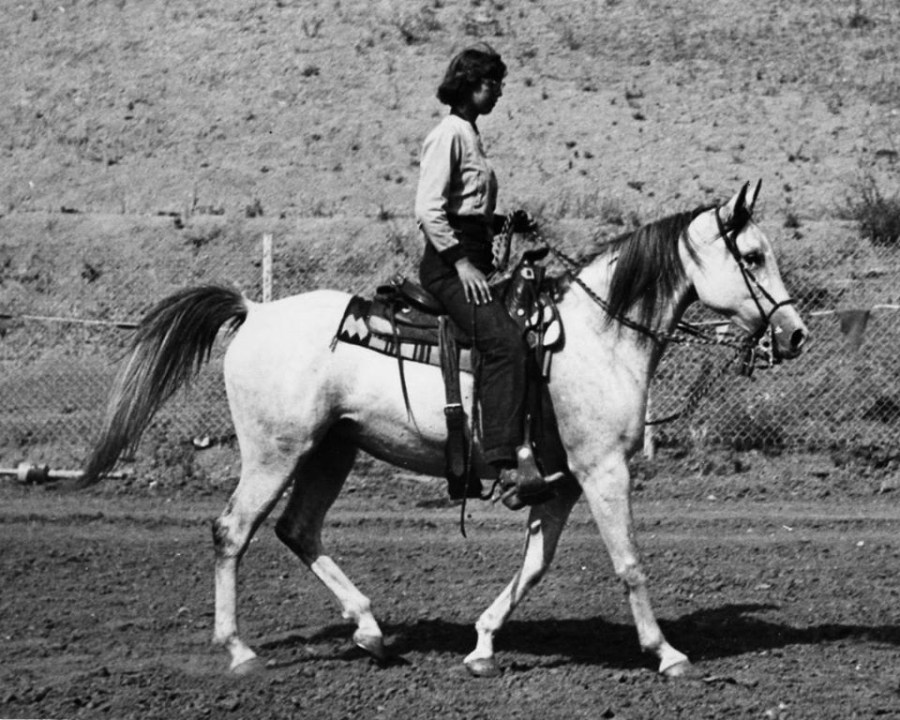
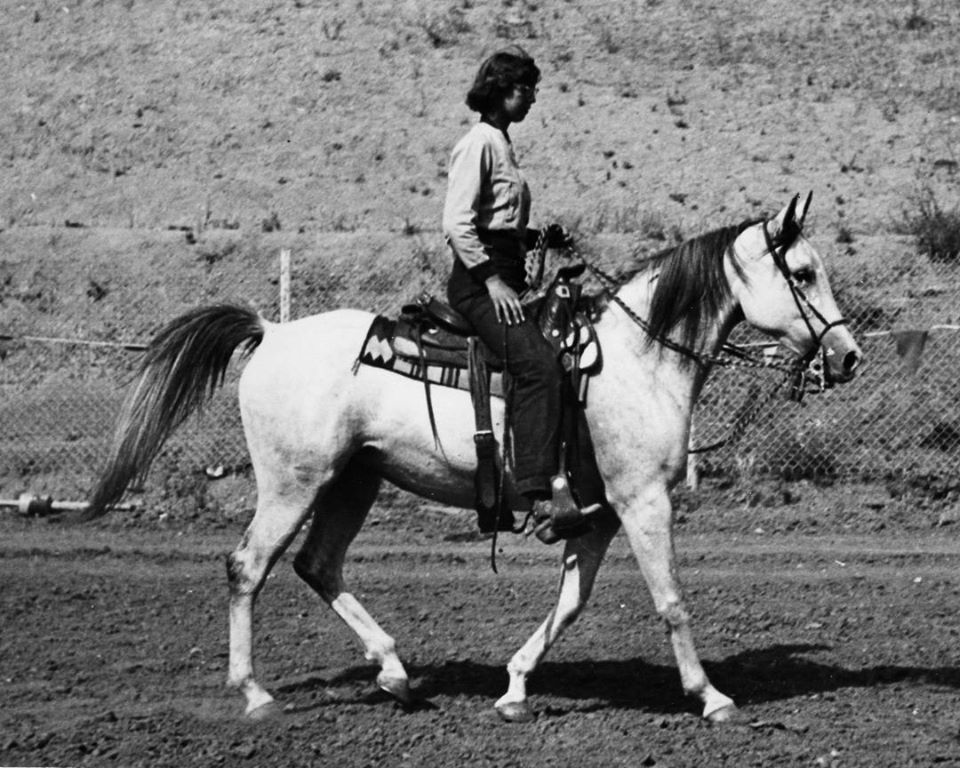
Sheila and Farlotta

Not too long ago a fellow horse loving friend loaned me the DVD, “The Legacy of Sheila Varian”. He said, “You’ll love this because it’s all about Arabians,” or something along those lines. I didn’t watch it right away because I figured it was a boring documentary about some rich lady and her horse farm. I finally popped it in a week or two later and found myself drawn in by this woman, who was the quintessential dreamer of dreams!

Sheila Varian did not come from a rich family. She fell in love with Arabians the same way I did, through reading the Black Stallion series by Walter Farley. Her parents weren’t horse people but supported her dreams and at the age of eight she started riding her first horse, a Morgan/Percheron mix and because money was tight, learned to ride bareback. She didn’t acquire her first saddle until the age of twelve.

Horses were in Sheila’s blood, heart and soul from the start and while working as a high school physical education teacher, she worked toward her dream. Farlotta was her first Arabian and most beloved of all. When Farlotta passed on to the rainbow bridge at the young age of seven due to health problems, Sheila was holding her cherished mare’s head in her arms.

Sheila later acquired the mare Ronteza, who would set Sheila on her way toward creating her legacy. In 1961 Sheila and Ronteza won the Open Reined Cow Horse Championship at The Cow Palace in San Francisco, California. She was the first amateur, the first woman and had the first Arabian to take the title.

Through acquiring mares from Poland and careful breeding over the years, Sheila Varian created the dynasty that is now known as Varian Arabians. Her is a link for the video that tells the story of this great lady and her legacy:
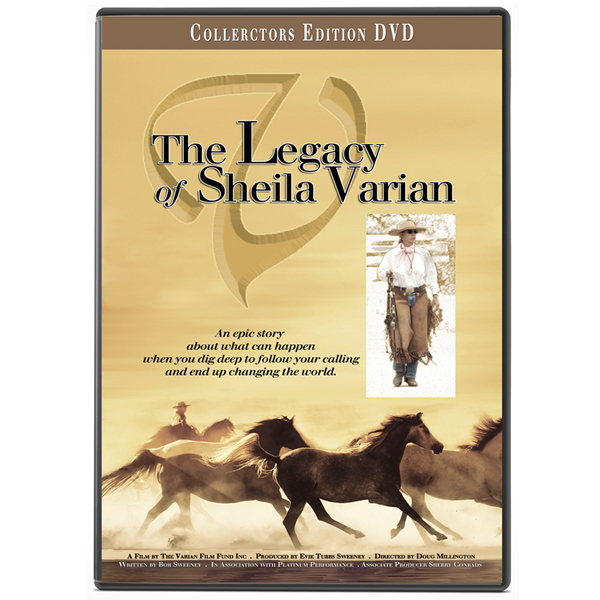
The Legacy of Sheila Varian

At one point in the documentary Sheila talked about following your dreams. I can’t remember the exact quote, but what she said really made an impression on me. This woman was not rich, or beautiful (in the traditional sense), but she was driven. I’m sure she encountered pain and roadblocks along the way, but she didn’t let that stop her. She lived the life she wanted and that is inspiring!
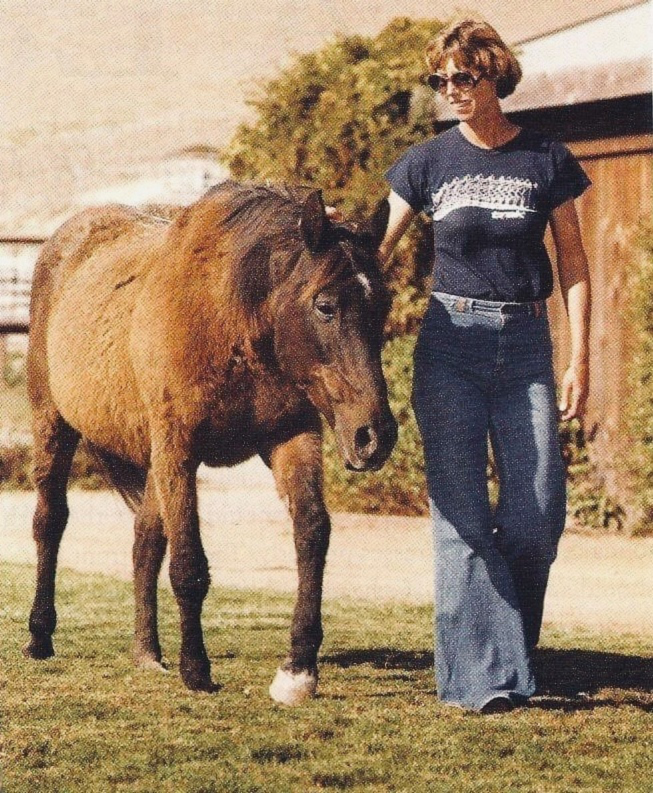
Sheila and Ronteza

Marwari-The Desert Horse of India

The Marwari is a rare and ancient breed of horse that originated in the Marwar region of western India. The breed is easily recognizable due to its inwardly curved ears. The Marwari is believed to be descended from the warhorses of the Rajput warriors of the Marwar region.

The origins of the Marwari horse are uncertain, but the breed is likely to have been influenced by Turkoman type horses brought to the area by Mughul invaders, as well as the Arabian horse. There is an Indian legend that seven Arabian horses of good breeding were shipwrecked off the shore of the Kachchh District and were taken to the Marwar region to be used as foundation bloodstock for the Marwari. Like the Arabian, the Marwari is know for its hardiness and also like the Arabian they were bred as warhorses. They were renowned for their courage in battle and loyalty to their riders. It was said that a Marwari horse would only leave a battle under three conditions; victory, death, or carrying its master to safety.

Maharana Pratap on Chetak, Moti MagriUdaipur, by Ankur P

Chetak was a legendary Marwari horse. The grey stallion purportedly carried Maharana Pratap to safety after he slayed the last of the Moghuls in the battle of Haldighati. The courageous stallion was said to have been brave enough to take on an elephant and reared so that Pretap was able to kill the Moghul who sat atop the war elephant. Chetak was mortally wounded by the elephant’s tusks, but he carried his master to safety, traveling many miles before dying near a river.

The Marwari were almost eliminated during the British rule of India during the early 1900s. The British preferred their thoroughbreds and polo ponies and ridiculed the horses with the inward turning ears. Even after independence from Britain, the Marwari horse was still endangered because war horses were no longer needed and many of the Indian nobleman who bred them had lost their land.

The Marwari horse was on the verge of extinction until Maharaja Umaid Singhji stepped in to save them and his work was continued by his grandson, Maharaja Gaj Singh II.

Later in 1995 a British horsewoman named Francesca Kelly founded the group, Marwari Bloodlines. Then, along with her husband, Raghuvendra Singh Dundlod, they led a group in 1999 that founded the Indigenous Horse Society of India which helps promote and preserve the breed.

Ashwarya aka Rae Rae

Ashwarya who is named after a Bollywood actress is currently residing at The Kentucky Horse Park and she was donated to the park by Francesca Kelly. She’s the only Marwari horse in the U.S. presently as far as I can tell due to the fact that India does not allow the export of the breed at this time. According to my research, Francesca Kelly has since moved the rest of her Marwari brood to the UK. If anyone is aware of others in the U.S. I’d love to hear from you.

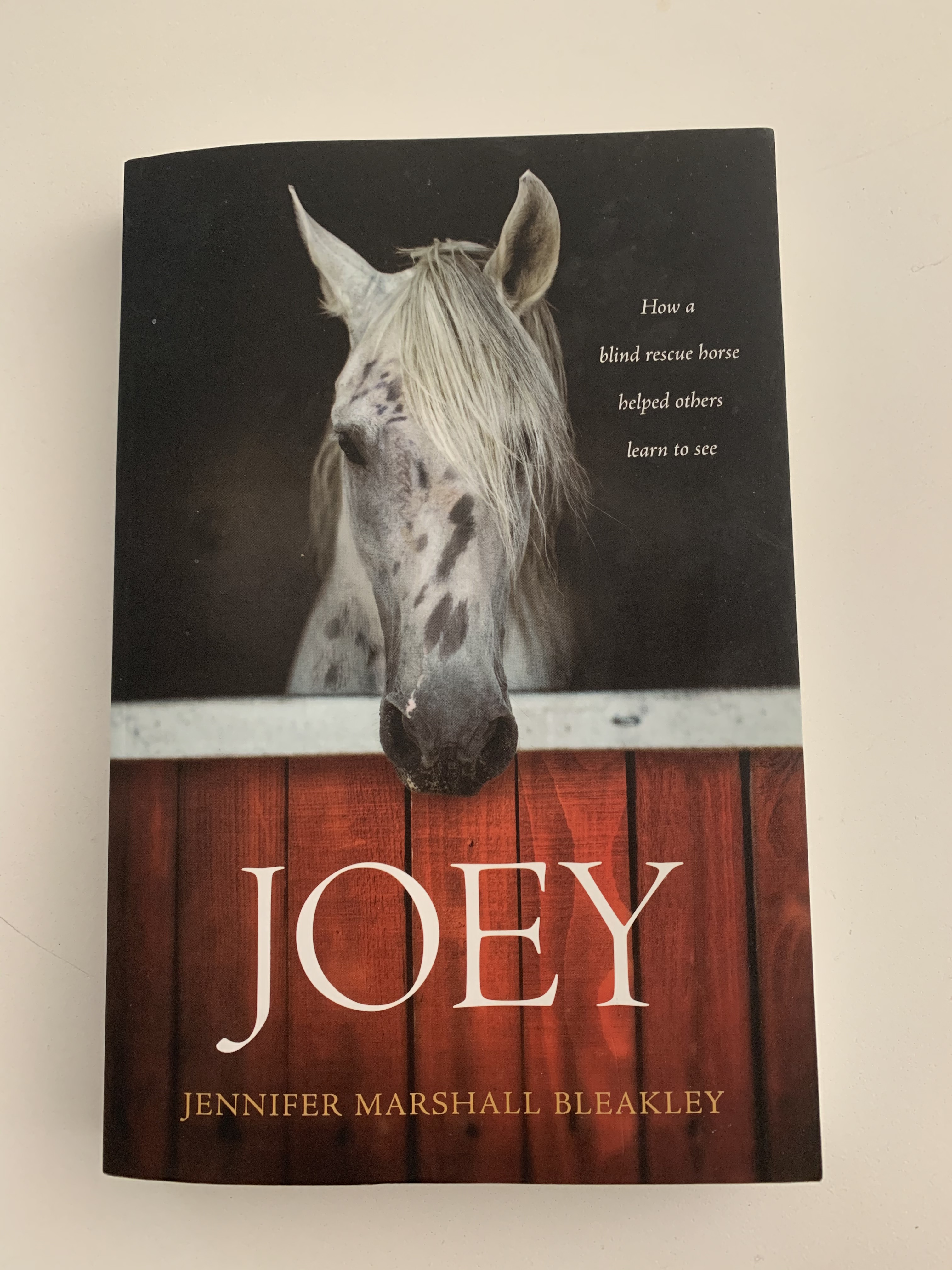
Book Review-Joey by Jennifer Bleakley

Joey Book Cover

Joey is the biography of a horse, but not a famous horse like Man O’ War or Seabiscuit, just a regular horse that was saved from bad circumstances and in return rescued his rescuers.  Everyone who ever meets Joey can’t help but fall in love.  Joey had been a show horse early on, but after an injury ended his show career he was passed from owner to owner and eventually ended up in a neglectful situation, which often happens to horses who are considered no longer “useful”.  At some point during this time he went completely blind, which was probably due to malnutrition.

Along comes Kim Tschirret who has a dream to unite troubled horses with troubled kids and Hope Reins is born. Joey along with another Appaloosa, named Speckles, arrive together at the fledgling therapy horse ranch to be among the first group of horses to help troubled kids.  The volunteers at the ranch, along with Kim, learn as they go and have to face special challenges brought on by a blind horse like Joey.  The book is inspiring because they learn and adapt to Joey’s needs as well as the needs of the children entrusted to their care.

There is a strong Christian theme to this book, which I thought might be off-putting for me because I am not particularly religious; although I do believe in a higher power.  But, it’s actually heartwarming following the main players and how each of them addresses their individual faiths and hope in God and the miracle that is Hope Reins.

Warning; tears will be shed in the reading of this book.  Sometimes the tears will be because of sadness, but mostly because the book is heartwarming.  Reading this book strengthened my belief in the something more that all of us can have faith in and the ability of some people to truly access the goodness with themselves.  I highly recommend this book for horse lovers and anyone who wants further evidence that there is true kindness to be found amongst the humans.

This book was a gift from my beloved Franch horses:

Joey Inside Book Cover

Pretty sure my dear friend, Julz, helped them pick it out! 😉

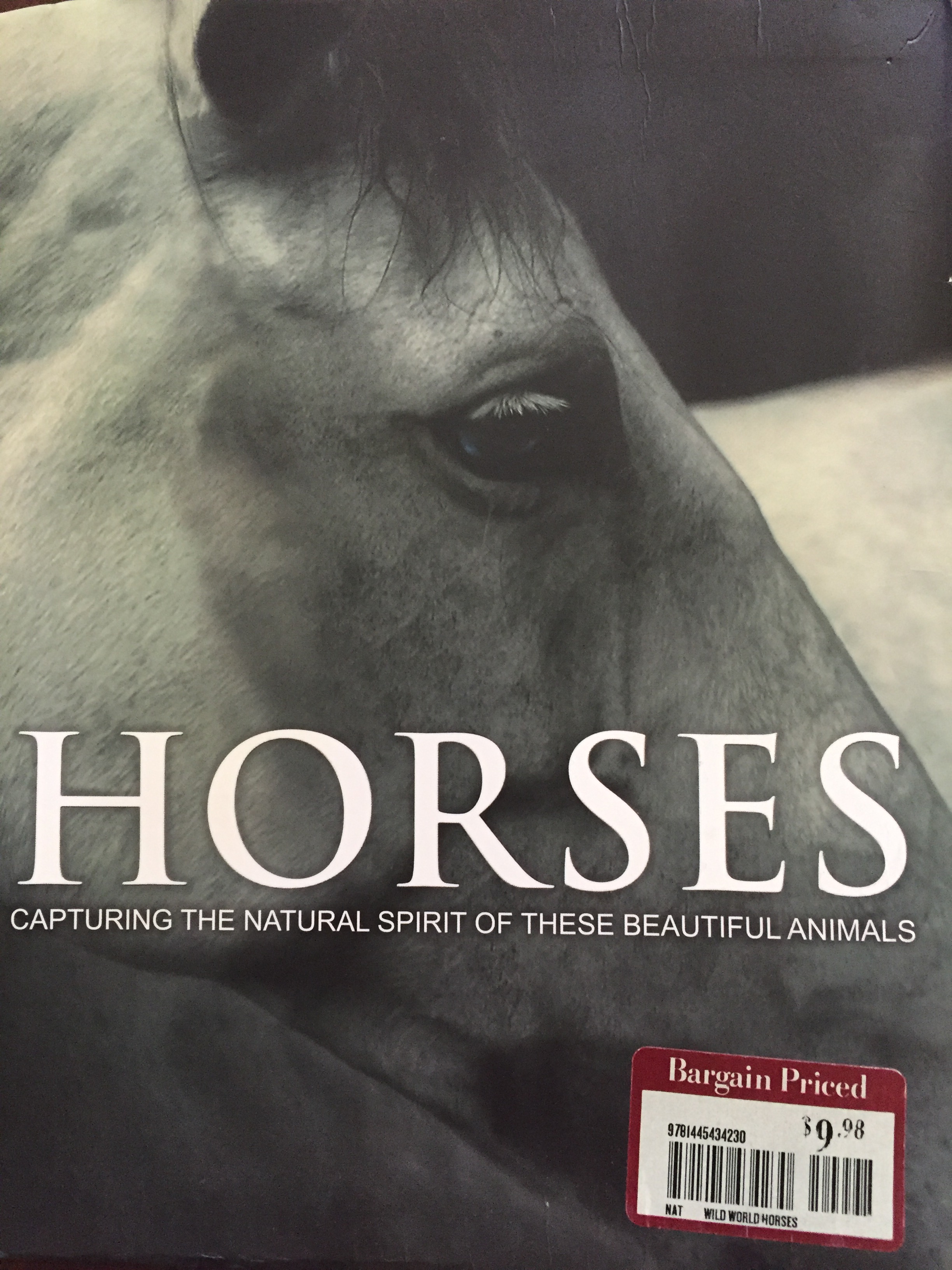
Bargain Table Horse Books and Arabians

IMG_4353

It seems that every horse coffee table book I’ve ever picked up from a book store bargain table always includes Arabian horses.  I started thinking about this because I was disappointed that the book pictured above doesn’t contain one of my favorite breeds, Marwari.  But then I thought, well, I guess it would be pretty impossible to include every breed of horse in every coffee table book.  But then I thought further and realized they always include Arabians.  (At least the ones I’ve seen.)

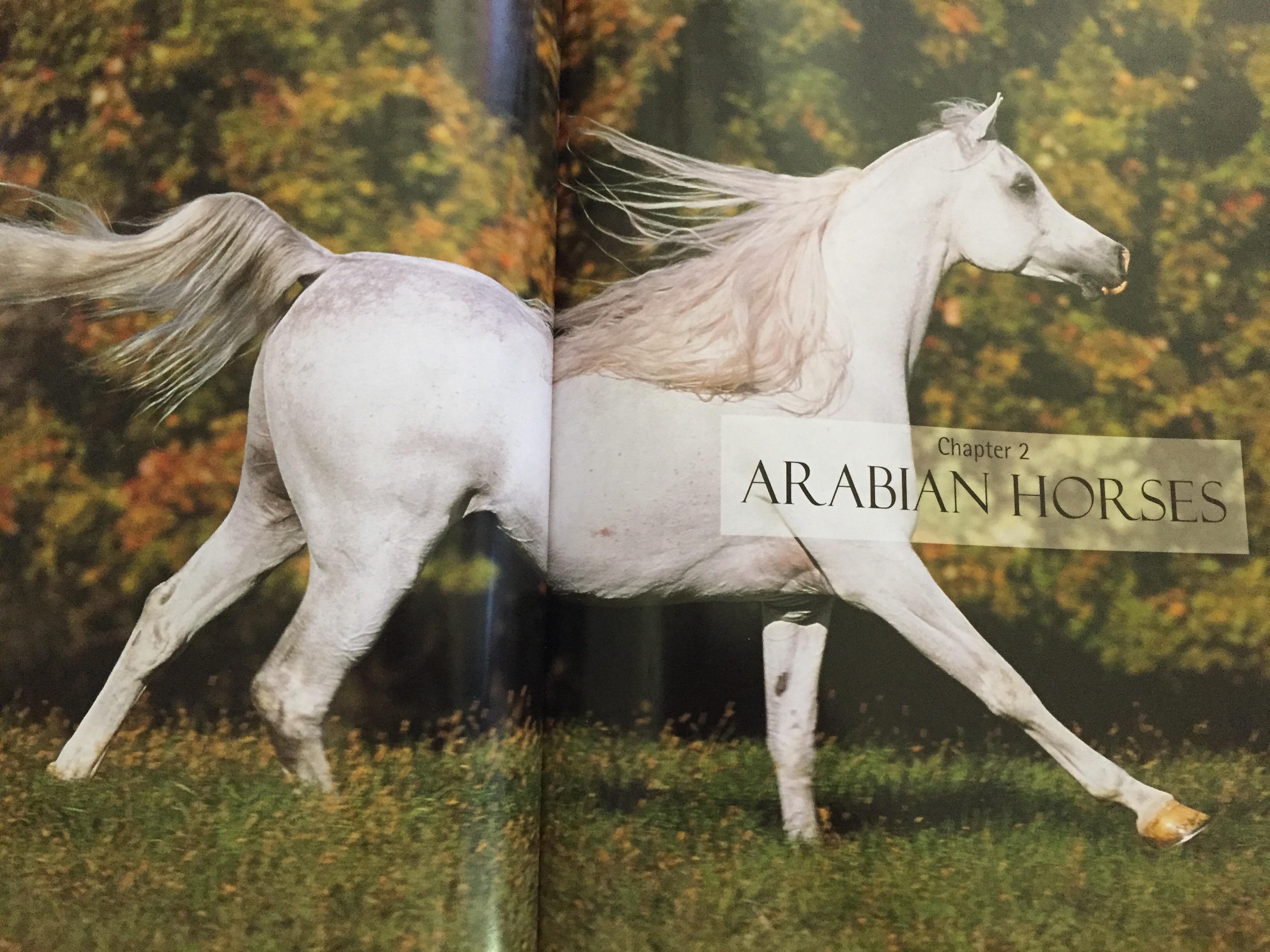
This book even has one section completely devoted to them:

IMG_4354

While the rest of the breeds are grouped into categories:

IMG_4355

A quote from the book: “With his tiny curved ears, large liquid eyes, extravagantly dished face and luxurious mane and tail, the Arabian is the horse of dreams.”

Another quote: “This beautiful ancient breed is thought to go as far back as 3000BC and has strongly influenced many of today’s more modern breeds of horse.”

I’ve been aware for some time that the Arabian horse influenced many other breeds, most notably the thoroughbred through the three foundation stallions;

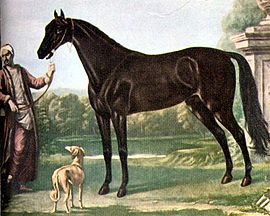
The Byerley Turk:

270px-Byerly_Turk
The Byerley Turk by John Wootton

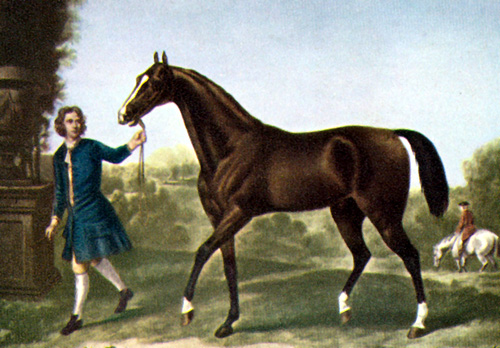
The Darley Arabian:

Darley_Arabian
The Darley Arabian stallion painting by John Wootton

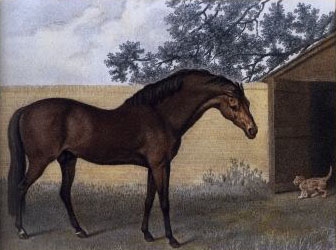
And the Godolphin Arabian (my personal favorite):

Godolphin_Arabian
The Godolphin Arabian, by George Stubbs

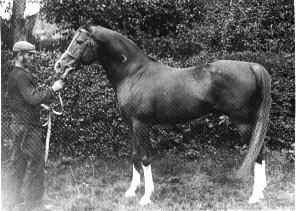
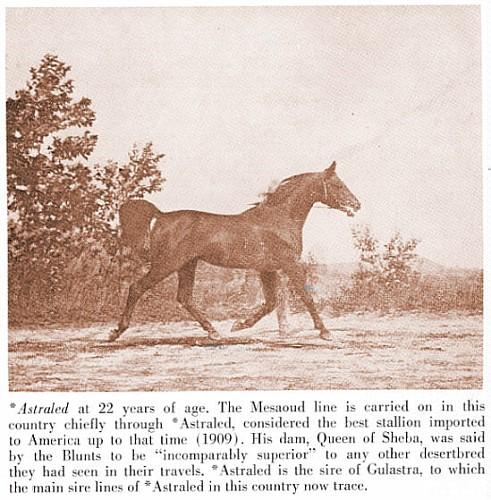
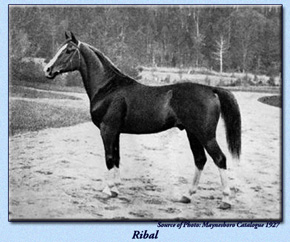
(I’ll write more about these three Arabians in another post.)  I was surprised to learn that Arabians also directly influenced the American Quarter Horse.  Growing up in Texas, it always seemed that Quarter Horse owners and Arabian owners are of different mindsets.  It still seems that way actually. So other than a little Arabian blood coming through to the American Quarter Horse via early Thoroughbred foundation stallions, I had no idea that there were full blooded Arabians among the early Quarter Horses until I read an article in the December 2018 issue of Equus that mentioned two Crabbet-bred Arabians who were direct sire-line descendants of Mesaoud, one of the foundation sires of the Crabbet Arabian Stud in England.

Mesaoud
Mesaoud at Crabbet Park

The stallions were Astraled and Ribal:

Astraled

ribal2

I never tire of learning about Arabian horses and their influence on other breeds and their appearance throughout human history.  I have much more to learn about the Arabian horse, but as in everything I love, I am a life-long learner.  I welcome comments and additional information as I know this blogpost just barely scratches the surface. I’m learning as I write!

Al Khamsa (The Five)

AlKhamsabiggerversion

Al Khamsa by Karen Kasper

All modern Arabian horses are said to descend from five original mares.  There are many versions of the story of Al Khamsa, but the one that seems to be the most popular is the one in which it is said that after a long journey, Mohammed released his band of horses to drink water at an oasis, but then blew his battle horn and only five of the mares stopped and returned to their master in spite of their great thirst.  The legend goes that these five mares were chosen to be the foundation mares for the Arabian breed because of their loyalty to their master.

The five strains named after these mares are, Keheilan, Seglawi, Abeyan, Hamdani, and Hadban, or various spellings there of.

In her book, The Classic Arabian Horse, Judith Forbis tells an albeit less magical story about the origin of the five mares in which several tribes from Yemen come to visit the prophet Mohammed and present him with “five magnificent mares, belonging to five different races of which Arabia was then said to boast.” In her version, Mohammed steps out of his tent, caresses them and says, “Blessed be ye, O Daughters of the Wind.”

Also in Forbis’s book she states that Carl Raswan, who was a well known historian of early Egyptian Arabians and lived among Arab tribes for over a decade, did not acknowledge all five strains.  “Raswan divided the Arabian breed into three main strains,…Saklawi was representative of feminine elegance, grace, and refinement, while Kuhaylan, signified masculinity, strength, boldness and power.  The Muniqi strain was of a racier build, usually more developed in the forehand and lighter behind.”

The Al Khamsa may be stuff of legend, but according to alkhamsa.org, “Any horse in North America that Al Khamsa, Inc. believes, after study, to descend entirely from Arabian horses bred by the nomadic Bedouin horse breeding-tribes of the Arabian Peninsula is an Al Khamsa Arabian.”

Timmy the Rescue Pony-Star of “Timmy Tales”

CuteTimmyatcar

Timmy is one of my two rescue horses who now calls The Franch home.  He is a sweet loveable pocket pony who loves everyone.  He has never been ridden and I estimate his age to be around nine at the time of this writing.  He was rescued from a severe neglect situation along with 63 other horses in Lewisville, Texas in 2009 by Anastasia Keyser of Hope for Horses Equine Rescue Inc.

Here is a before photo of a small group of the rescues back in October 2009:

LewisvilleHorses10-09003

Timmy was less than a year old at the time, so he may have been too young to remember much of what happened, considering how much he trusts people.  Most of the rescues were Pony of the Americas, Haflingers and a few other breeds.  He has the coloring of a Haflinger, so I just like to say he’s half-Haflinger and half Pony of the Americas, but he’s just really my sweet, cute, funny little boy!

Timmy in the pasture:

Timmyinthepasture

Timmy and his best friend, Frisco (my other rescue horse):

FriscoandTimmy

Timmy and me:

Timmyandme