
Al Khamsa by Karen Kasper
All modern Arabian horses are said to descend from five original mares. There are many versions of the story of Al Khamsa, but the one that seems to be the most popular is the one in which it is said that after a long journey, Mohammed released his band of horses to drink water at an oasis, but then blew his battle horn and only five of the mares stopped and returned to their master in spite of their great thirst. The legend goes that these five mares were chosen to be the foundation mares for the Arabian breed because of their loyalty to their master.
The five strains named after these mares are, Keheilan, Seglawi, Abeyan, Hamdani, and Hadban, or various spellings there of.
In her book, The Classic Arabian Horse, Judith Forbis tells an albeit less magical story about the origin of the five mares in which several tribes from Yemen come to visit the prophet Mohammed and present him with “five magnificent mares, belonging to five different races of which Arabia was then said to boast.” In her version, Mohammed steps out of his tent, caresses them and says, “Blessed be ye, O Daughters of the Wind.”
Also in Forbis’s book she states that Carl Raswan, who was a well known historian of early Egyptian Arabians and lived among Arab tribes for over a decade, did not acknowledge all five strains. “Raswan divided the Arabian breed into three main strains,…Saklawi was representative of feminine elegance, grace, and refinement, while Kuhaylan, signified masculinity, strength, boldness and power. The Muniqi strain was of a racier build, usually more developed in the forehand and lighter behind.”
The Al Khamsa may be stuff of legend, but according to alkhamsa.org, “Any horse in North America that Al Khamsa, Inc. believes, after study, to descend entirely from Arabian horses bred by the nomadic Bedouin horse breeding-tribes of the Arabian Peninsula is an Al Khamsa Arabian.”
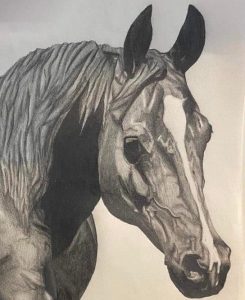


 Dreaming of Arabians